
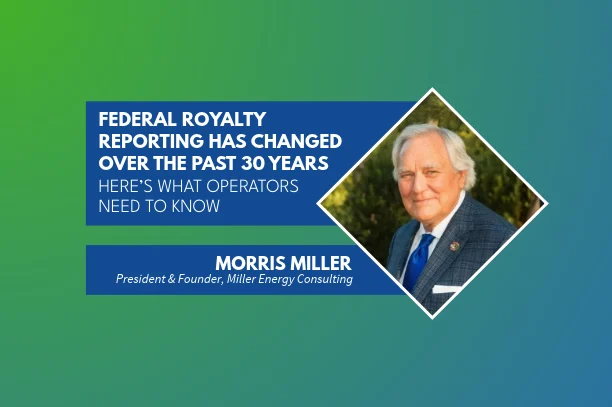
Federal royalty reporting has changed dramatically over the past 30 years. Operators are no longer just reporting production, sales, deductions, and royalties owed on federal or Indian leases. They also need to understand how value is determined, which costs can be deducted, how those deductions are supported, whether older reporting methods still hold up, and how ONRR may review those positions later. Doing that well requires broad oil and gas experience and a deep understanding of how federal royalty regulations and reporting expectations have evolved over time.
For more than three decades, Morris Miller of Miller Energy Consulting, LLC, has worked through these issues from the government side, the operator side, and the consulting side. Now, by partnering with Martindale Consultants, operators have access to Morris’s specialized federal royalty reporting and unbundling expertise alongside Martindale’s broader oil and gas accounting, audit, and regulatory consulting experience. That combination is a major advantage for companies trying to keep up with changing expectations, evaluate legacy reporting methods, support allowable deductions, and respond to ONRR questions with a more complete understanding of both the regulations and the business behind the reports.
Federal royalty reporting has always required accuracy, but the level of analysis behind the reporting has changed. Earlier reporting situations were often more straightforward. As gas marketing, midstream contracts, and federal interpretation evolved, operators had to look more closely at the facts behind each reported value and deduction.
The practical result is a more detailed reporting environment. Clean accounting records are important, but they do not eliminate royalty reporting risk if the methodology behind those records is outdated, incomplete, or unsupported. Operators need experience that can connect current requirements with the regulatory history and business facts behind the report.
Unbundling is one of the clearest examples of how federal royalty reporting became more complicated. As gas marketing and midstream arrangements changed, operators were no longer always dealing with simple, clearly separated costs. A single fee or settlement line could include gathering, compression, dehydration, treating, transportation, processing, fuel, lost and unaccounted-for gas, and other services. For federal royalty reporting purposes, those services cannot always be treated the same way.
Unbundling is the process of separating a combined fee into the portions that may be deductible and the portions that are not. The goal of unbundling is not simply to reduce royalties or apply a formula across the board, but to report royalty value accurately based on what the fee actually covers, which costs federal rules allow, and how those costs can be supported.
Unbundling made federal royalty reporting more demanding because operators had to look beyond contract labels and settlement statements. A fee called “transportation” or “processing” may still need closer review if it includes other services, while a supportable analysis may require contracts, plant records, cost data, system maps, gas movement information, operational input, and regulatory interpretation. Without that deeper review, an operator may deduct too much, miss deductions it is entitled to take, or lack the documentation needed to defend its reporting later.
Morris Miller’s experience is especially relevant because he was involved as unbundling became a major federal royalty issue. As a former Minerals Management Service auditor, he helped identify early systems where bundled fees created reporting concerns. Later, working from the operator and consulting sides, he helped companies evaluate allowable deductions, develop unbundling methodologies, prepare cost-of-service calculations, and rebuild historical reporting when prior methods no longer aligned with updated expectations. In some cases, that meant reconstructing years of royalty reporting so companies could get back on track and support their positions under ONRR review.
Many operators still face these issues today through acquired assets, older contracts, inherited reporting methods, or internal processes that have not been reviewed in years. The current team may know how the monthly report is prepared, but not why the methodology was created or whether it still reflects the current facts. Unbundling exposes those gaps and reinforces why federal royalty reporting needs regulatory, accounting, operational, and contractual expertise working together.
Federal royalty reporting has changed through regulations, audits, court decisions, agency interpretation, industry practice, and practical problem solving. Morris has been part of that changing landscape from several positions: government auditor, operator, consultant, methodology developer, audit support resource, and industry educator. His experience includes reviewing royalty reporting from the agency side, helping operators apply changing requirements, supporting unbundling methodologies, rebuilding historical reporting, and explaining federal royalty issues to industry professionals as expectations evolved.
For operators, the value of that background is practical. It helps identify where older reporting practices may create risk, where documentation may be too thin, and where current ONRR expectations may not match the assumptions behind a company’s existing process.
Even a reasonable original method can become risky when the facts change. A plant may be modified, a gathering system may expand, a contract may be amended, or a fee may begin covering services it did not include before. Documentation can also become harder to locate as staff changes, assets change hands, or systems are converted. Periodic review helps operators confirm whether the contract, physical flow, services performed, cost support, allowance calculation, and documentation still support the method being used.
Problems often begin when those groups are not connected. A contract amendment may affect deductions. A system change may affect an unbundling methodology. An acquisition may bring in old assumptions. A plant or gathering change may affect cost allocation. When accounting receives incomplete information or learns about changes too late, the royalty report may not reflect the full business reality. Strong reporting methods usually come from accounting, operational, contractual, and regulatory information working together.
Waiting can make the work harder. If ONRR questions a deduction, the company may have to reconstruct years of data, explain decisions current staff did not make, locate missing support, and defend a methodology that has not been reviewed in years. The burden can grow quickly when the issue involves many wells, long reporting periods, complex contracts, or bundled fees. A proactive approach helps companies understand what they are reporting, why they are reporting it that way, and whether the support exists to defend it.
Federal royalty reporting has become more complex because the oil and gas business has become more complex. Through Martindale Consultants’ partnership with Morris Miller, operators have access to specialized federal royalty reporting and unbundling expertise backed by our broader oil and gas accounting, audit, and consulting experience. That breadth matters because accurate reporting depends on connecting ONRR requirements to revenue accounting, contracts, deductions, ownership, operations, documentation, acquisitions, and audit readiness. When those pieces are evaluated together, operators can strengthen reporting methods, better support allowable deductions, and reduce the risk of costly corrections later.
Together, Morris and Martindale give operators a more complete federal royalty reporting resource, with work that is not limited to preparing reports or reviewing deductions in isolation. It includes understanding the regulatory issue, connecting it to the company’s records and operations, and helping build support that can hold up under review.
From developing defensible reporting methodologies and supporting allowable deductions to preparing for audits, responding to regulatory questions, evaluating acquisitions, and planning for future growth, Martindale Consultants helps companies approach federal royalty reporting with the regulatory knowledge, accounting experience, and historical perspective needed to manage risk. With Morris Miller’s specialized federal royalty reporting and unbundling expertise integrated into Martindale’s broader oil and gas consulting services, operators can review legacy practices, strengthen documentation, and make more informed decisions about federal and tribal royalty reporting obligations.
To learn more about Martindale’s federal royalty reporting and unbundling support, contact our team today.
Fill out the form below, and we will be in touch shortly.
Fill out the form below, and we will be in touch shortly.