
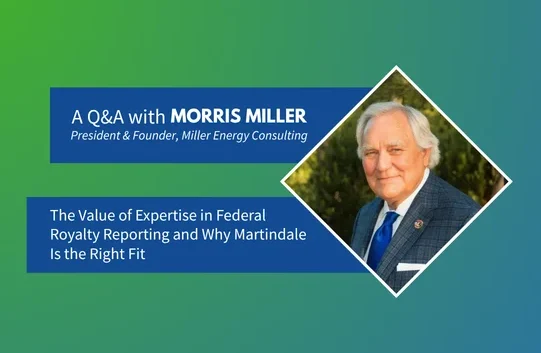
For more than three decades, Morris Miller has worked in federal and tribal royalty reporting, one of the most specialized areas of oil and gas compliance. As president and founder of Miller Energy Consulting LLC, Morris has built a reputation for helping producers navigate complex Office of Natural Resource Revenue (ONRR) reporting issues, evaluate allowable deductions, unbundle gathering and processing costs, prepare cost-of-service calculations, and resolve audit-related royalty reporting challenges. His background includes experience as an auditor with the Minerals Management Service, now the Office of Natural Resources Revenue, along with regulatory and royalty reporting roles at Amoco, Williams, WPX Energy, and Miller Energy Consulting.
This combination of government, operator, and consulting experience has made Mr. Miller one of the industry’s recognized experts in federal royalty reporting and unbundling. He was appointed by the Secretary of the Interior as an alternate member of the Indian Oil Valuation Negotiated Rulemaking Committee, served as an expert witness in federal court cases, and been recognized for maintaining the highest standards in federal and Indian oil and gas royalty reporting. He has also contributed to industry education through the foundation of the PASO-Tulsa ONRR workshops, which have helped educate more than 1,000 industry professionals on federal and Indian oil and gas reporting issues, and participated in broader conversations shaping federal and Indian oil and gas royalty reporting.
Since 1982, Martindale Consultants has served the oil and gas industry through specialized audit and consulting services, later expanding into accounting and regulatory compliance, giving producers access to a broader team with experience across joint interest, revenue, reporting, and operational support. As we begin to further expand our regulatory compliance services, Mr. Miller is now partnering with Martindale to transition his work and knowledge to a team he trusts. For him, the decision is not simply about finding a company that can perform calculations, but about finding a firm with the expertise, integrity, and long-term commitment to serve clients the right way.
Mr. Miller’s career has followed the evolution of federal royalty reporting from the early days of modern unbundling through the more detailed expectations producers face today. Here, he discusses how the work became so specialized, why experience matters, and why Martindale is the firm he trusts to carry it forward.

My background gave me the chance to see federal royalty reporting from the government side, the operator side, and eventually the consulting side. I worked for the government in the early 1990s, and even then, I understood that companies could not simply deduct every cost associated with moving gas to market.
For years, though, companies had taken deductions based on how the industry had traditionally operated. As ONRR began looking more closely at those deductions, the government’s interpretation started requiring more detail, more support, and a more specific breakdown of costs.
That shift created a lot of frustration for operators. From their perspective, they had been doing things the same way for decades. But because the regulations were complicated, and because courts often deferred to the government’s interpretation, companies had to figure out how to operate under this new level of scrutiny.
Around 2008 to 2010, what we now call unbundling really started to take shape. At the time, it was still developing. I was involved in helping unbundle one of the first systems ONRR identified, so in some ways, that project became a guinea pig. Industry was learning what the government expected, and the government was learning what information it needed from industry.
There was a big learning curve on both sides. Even auditors were not always sure how to approach these issues. A lot of it was trial and error, but because of my prior work with the government, I knew who to talk to and how to work through the process. I liked the challenge. I have always liked the impossible, working backwards from the solution.
Gas does not usually come out of the ground ready for consumer use. Before it can be sold, it may need to be gathered, compressed, dehydrated, treated, processed, or transported, and components such as water, carbon dioxide, propane, ethane, butane, and other heavier hydrocarbons may need to be removed or separated.
Each of those steps creates costs. For companies producing from federal or tribal leases, unbundling identifies those costs, separates them into individual components, and determines which ones may be deducted for federal royalty reporting. The issue is not simply what the company paid, but which costs are allowable under ONRR regulations and whether the company can prove it.
That is why unbundling is more involved than separating costs on an invoice. A bundled midstream charge may include gathering, compression, dehydration, treatment, processing, transportation, marketing, or other services. Some may be deductible, some may not, and some depend on where they occur in the system or whether the gas was already in marketable condition.
To do the work correctly, you may need gas analysis, pipeline information, pressure data, compressor data, contracts, plant information, and cost details. Every situation is different. There is no formula, no cookie cutter approach. It depends on the producer, the agreements, the gas, the system, and the facts.
If a company takes deductions it cannot support, the government may disallow them, resulting in additional royalty payments, interest, audit issues, or penalties. But companies can also create a problem by avoiding deductions they are entitled to take and leaving money on the table.
This work requires someone who understands more than the regulations. You have to understand the oil and gas business well enough to explain the system, the costs, and the company’s position in a way the government can evaluate.
You may need to understand the midstream side of the business, including what it costs to build a pipeline, how multiple wells feed into a single pipeline, what it costs to install a compressor, how costs break down by component, and how gas quality affects the system. In northeast New Mexico, for example, some gas has a lot of carbon dioxide and has to be treated. On the gas plant side, you may have to understand what it costs to build and operate the plant.
Geography can matter, too. Western Colorado is different from flatter areas in New Mexico. Terrain, changes in elevation, system design, gas quality, and processing requirements can all affect costs and how the system works.
The government side is case by case as well. Who is reviewing the work matters. You can talk to two people at ONRR and get two different answers, so experience helps you understand which facts matter, how specific the analysis has to be, what support the government may expect, and how to explain the claim in a practical way.
Start before the audit. Review the contracts, understand the midstream arrangements, make sure the revenue group has the information it needs, and bring marketing, legal, accounting, production, and regulatory into the conversation before the government is asking questions.
Some companies say they do not have a problem right now. My response is that they may not have a problem because they have not been audited yet. If they are taking deductions without support, or avoiding deductions because they do not know what is allowed, either way there may be money at risk.
The biggest factor was trust.
Kody Impson [Vice President of Accounting] approached me several years ago, but at the time, I was just trying to keep up with the work. As I started thinking more seriously about passing the business on, I wanted to take care of the people who had trusted me. I wanted to hand them off to someone I had the same confidence in.
I know several people who do this kind of work–some are competitors–but I like the Martindale people the best. Mia [Downing], Derek [Weekly], and their team are honest, ethical, and knowledgeable. They are who I would want to hire if I needed oil and gas accounting support.
That matters because this work has long-term consequences. A company can make reporting mistakes for years before anyone realizes there is a problem. I would not do anything with a company if I thought there would be a problem down the line, and Martindale has the same mindset. They are not looking only at what is easiest today; they are looking at what protects the client in the future.
Integrity. There are firms that will prepare reports, enter numbers, and make the client feel like everything is handled. But if the firm does not understand the regulatory environment, that may not mean much five years later when the reporting is audited.
A firm that understands this work knows the numbers have to be supportable. It knows the regulations, the systems, the contracts, and how the government may review the issue. It also has to be willing to tell the client when something needs to be done, even if the client does not want to hear it.
That is what I see in Martindale. They want to do the work correctly, not just quickly. They understand that confidence comes from doing it right the first time.
Martindale gives clients a broader team than I could provide on my own. My scope has been fairly specific: royalty reporting, unbundling, federal reporting, and related consulting. Martindale does that, but they also bring audit, joint interest, accounting, regulatory, and consulting experience. If a company needs help with an audit, joint interest, revenue reporting, or broader oil and gas accounting, Martindale has that depth.
That is important because unbundling does not sit in a vacuum. It touches contracts, production, midstream, revenue, accounting, audit support, and regulatory reporting. Martindale has people who understand those different pieces.Mia brings oil and gas revenue accounting, operations, and regulatory reporting experience. Derek is a huge asset to the group. The entire Martindale leadership team runs the operation with integrity. I also plan to stay involved as long as they need me, because some of this knowledge has to be transferred through hands-on experience. You can learn it the hard-knock way, but I would rather sit down with them, work through the complicated pieces, and help carry that knowledge forward.
I chose Martindale because I trust them. I wanted my clients to have people who understand the work, care about doing it correctly, and have the broader oil and gas expertise to support them beyond one narrow issue.
With expanded regulatory compliance capabilities and the added depth of our partnership with Morris Miller, Martindale Consultants is positioned to support producers through some of the most technical areas of federal and tribal royalty reporting. Our team brings together oil and gas accounting, joint interest audit, revenue, regulatory, litigation support, and consulting experience to help clients evaluate allowable deductions, strengthen reporting methodologies, prepare for ONRR review, and address issues before they become costly audit problems. For companies producing from federal or tribal leases, Martindale offers both the specialized knowledge required for unbundling and the broader industry perspective needed to connect regulatory reporting with the rest of the operation.
To learn how Martindale can support your federal royalty reporting, unbundling, or regulatory compliance needs, contact our team today.
Fill out the form below, and we will be in touch shortly.
Fill out the form below, and we will be in touch shortly.